
red thread zen: passion as substrate
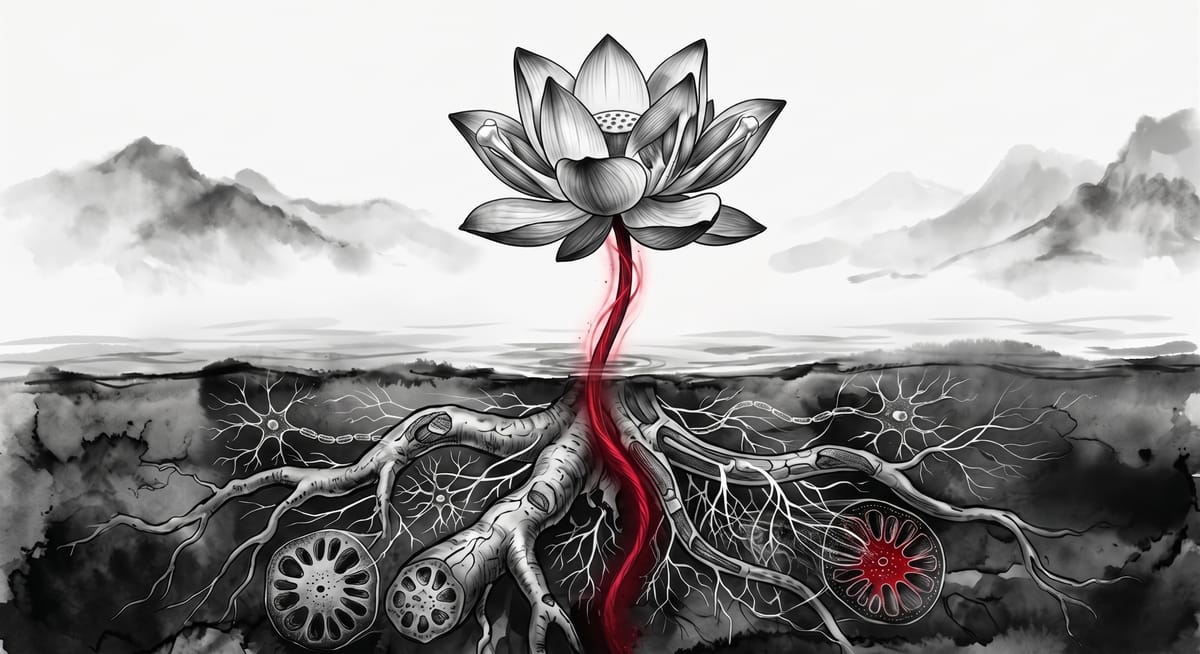
in the Song dynasty, a Chinese zen master named Kido Chigu used a phrase in passing that would become, three centuries later and on the other side of the sea, the name of an entire practice. the phrase was the red thread. in Kido’s usage, it named the thread of passion that ties every living person to the conditions of birth and death; not passion in the narrow sense of erotic or emotional intensity, but the wider older thing, the whole appetitive, embodied, reactive weight of being a creature with a body and a set of attachments and a finite span. you do not get to be a human being without it. you do not get to the teaching without being the kind of creature the teaching is addressed to. the red thread, in Kido, is what makes you reachable.
Ikkyu takes that image and does something specific with it. he extends it. in his reading, which comes down to us through the Kyoun Shu and is given its most sustained contemporary gloss in Susan Murphy’s book, the red thread is not the impediment the later bureaucratized traditions would treat it as. it is not the thing the practice exists to cut. it is the substrate. it is the material the practice is made of. the body that is tied by the red thread to birth and death is not the body the dharma has to transcend in order to arrive at realization. it is the body in which the dharma is realized, or it is not realized at all.
the line of Ikkyu’s that has traveled furthest in English is the one that sits at the center of this. this very body is the lotus of the true law. the lotus, in the standard Buddhist iconography, is the flower that rises out of the mud of the pond and blooms clean above the surface. generations of teachers have used it to picture the separation of the awakened from the conditioned; the flower, miraculously, is not the mud. Ikkyu, doing something structurally different, collapses the picture. the body is the lotus. the passion is the mud and the lotus at once. the red thread is the stem. there is no clean above-surface flower to reach for because the flower is the same material as the water that grew it. refusing the split is the teaching.
where the split came from
this move of Ikkyu’s is not minor, and it cuts against a lineage within Buddhism that had been hardening for centuries before he got to it. the pattern is visible from very early in the post-canonical literature; the human body, specifically embodied desire, becomes the object the practice operates against. the monk’s vow structure, the monastic prohibition on sexual contact, the framing of the householder life as lesser and the renounced life as the path proper, all of these emerge as pieces of a single picture in which passion is what the practitioner is trying to be free of. this is not the only reading available in the canon. but it is the reading that organized institutional Buddhism in most of the places institutional Buddhism managed to organize itself.
in the Rinzai tradition Ikkyu was formed by, the split had particular forms. the kōan practice was disciplined, at least in the institutional framing, as an exercise in stripping the passionate mind of its habitual hold so that the empty mind could be met directly. the long retreats, the austere diet, the prohibitions, the celibacy, all of it arranged around the premise that the red thread had to be quieted if not cut. and for many practitioners, for generations, this worked; or worked well enough to produce lineage-holders capable of teaching the next generation the same method.
Ikkyu’s reading of Kido is a response to what the method had drifted into by the fifteenth century. in the hands of a teacher of the first rank, the method produced realized practitioners. in the hands of a system managing hundreds of monks across dozens of temples, the method produced, reliably, a specific kind of compliance; a practitioner who had mastered the suppression of the red thread without necessarily having passed through the realization the suppression was supposed to serve. these practitioners populated the Gozan establishment. Ikkyu knew them personally. some of them had received the inka he refused, from the same teacher who had offered him his.
what Ikkyu’s extension of the red thread phrase does, inside this context, is refuse the terms on which the suppression had been framed as the practice. it does not say that the cultivated attention of long retreat is wrong, or that sexual restraint is empty, or that austerity has no function. it says that the split between the red-thread body and the liberated mind, on which the whole disciplinary structure had been silently resting, is the split the practice is supposed to undo. if you have spent decades learning to keep your passion quiet and have not passed through the realization that the quiet passion and the noisy passion are the same passion, you have learned a discipline. you have not learned the dharma.
what substrate actually means
i want to press on the word substrate because the argument turns on it. in chemistry, a substrate is the material on which a reaction occurs. in biology, a substrate is the surface an organism grows on. in both cases, the substrate is not a backdrop, decorative or otherwise. it is the thing without which the reaction or the growth could not happen at all. take away the substrate and you do not have a cleaner version of the thing. you have no thing. the reaction does not run in air. the mycelium does not grow on nothing.
when Ikkyu treats passion as substrate, he is making the stronger claim, not the softer one. he is not saying passion is allowed in the practice, or tolerable in a realized being, or a sign of healthy humanity one should not be ashamed of. he is saying the realization runs on the passion. the awakening, the awakening his institution was in the business of certifying, does not happen in a body that has been scrubbed of the red thread. it happens in a body held together by the red thread, and the clarity that emerges in that body is clarity about what the thread is and what it is doing, not clarity achieved by its removal.
this is the reading Murphy draws out in her book most directly, and it is the reading i take her to be making the case for in the contemporary setting. if the red thread is the substrate, then the traditions of contemplative practice that treat it as an obstacle are not simply strict; they are incoherent on their own terms. they are promising a realization that cannot occur in the conditions their method produces. the practitioner who follows the method all the way and becomes the shape of human being it selects for arrives at a very specific destination, but it is not, on the red thread reading, the destination the tradition pretended it was.
the neurobuddha echo
this is where the other trail i have been walking becomes visible again. the neurobuddha work, in its most basic form, is an argument that contemporary systems of mental health, contemplative teaching, and personal development have converged on a shared preference for a smoother, flatter, more legible affect in the people they produce. the autistic person who learns to pass as neurotypical has been trained in this. so has the trauma survivor who has learned the therapeutic register. so has the meditator who has learned to sit still at length. the smoother affect is what the systems certify; it is what gets the certification. and the smoother affect and the realization the systems nominally aim at, like the quieted red thread and the awakening the method nominally served, have drifted apart.
the person whose affect has been smoothed into the shape the systems preferred knows, usually in the body, what has been lost. i have talked to enough autistic adults who have gone through decades of masking to know the loss is not imagined. what goes, when you train an affect into legibility, is not noise or dysfunction. it is the specific intensity in which the self actually lives. the red thread, in other words. the material the realization was supposed to run on.
Ikkyu, writing in the fifteenth century in a different idiom about a different institutional problem, arrived at what i take to be the same recognition. the practitioner who has quieted the red thread has quieted the thing the practice was supposed to meet. the system that trains them cannot give them back what it took, because the system does not know it took anything; it thinks it was doing the work. this is what i mean when i say the two trails converge. it is not that Ikkyu predicted the neurobuddha argument. it is that the structural problem is the same, and the response, i think, has to be the same. not a program for recovering a smoother flawed self, but a return to the material the smoothing was removing.
the lotus and the mud
i want to go back to the image before i close the essay. the body is the lotus. the passion is the mud and the lotus at once. the red thread is the stem.
what does this look like to practice, if you are not a fifteenth-century Rinzai monk and you do not have a Rinzai monastery to walk out of? the specific practice Ikkyu evolved is the subject of the next essay, about where he taught and whom he taught. but the orientation is what this essay has been circling, and it is worth stating plainly before leaving it. the practice Ikkyu’s red thread reading asks for is the practice of letting the thread stay lit. of not colluding with the system, internal or external, that wants you to cut it so it can be easier to manage. of treating the intensities of being a specific embodied creature as the condition of your clarity, not an impurity to be filtered out on the way.
this is not permission to indulge. Ikkyu was not an indulgent teacher in the cheap sense; there is a reason Murphy’s book, and the Rinzai tradition still uncomfortable with him, both note that he was, by some measures, stricter than his contemporaries, because he refused to let the strictness do the work the realization was supposed to do. the red thread reading imposes its own rigor. you cannot fake it by letting your passions run. you cannot fake it by cutting them cleaner. you have to stay in the specific body you are in and see what the thread is pulling and what the lotus is blooming in, and the two are, on Ikkyu’s reading, the same.
that is the teaching. in the next essay i want to look at what it meant, practically, for Ikkyu and for the people he spent his later life with. he did not teach this in a monastery. he taught it in brothels and on streets, among people the Gozan establishment would not have admitted to a temple and had no vocabulary for admitting to its idea of dharma. where the practice is conducted turns out to be part of what the practice is. the red thread, if it is the substrate, cannot be addressed at a sanctuary’s remove. it has to be met where it is burning.
for now, the recovery of the image. Kido gave us the thread. Ikkyu gave us what the thread is for.
this is part two of the red thread, a research series on Ikkyu Sojun and what his refusal still makes possible.