
the griot in the diaspora
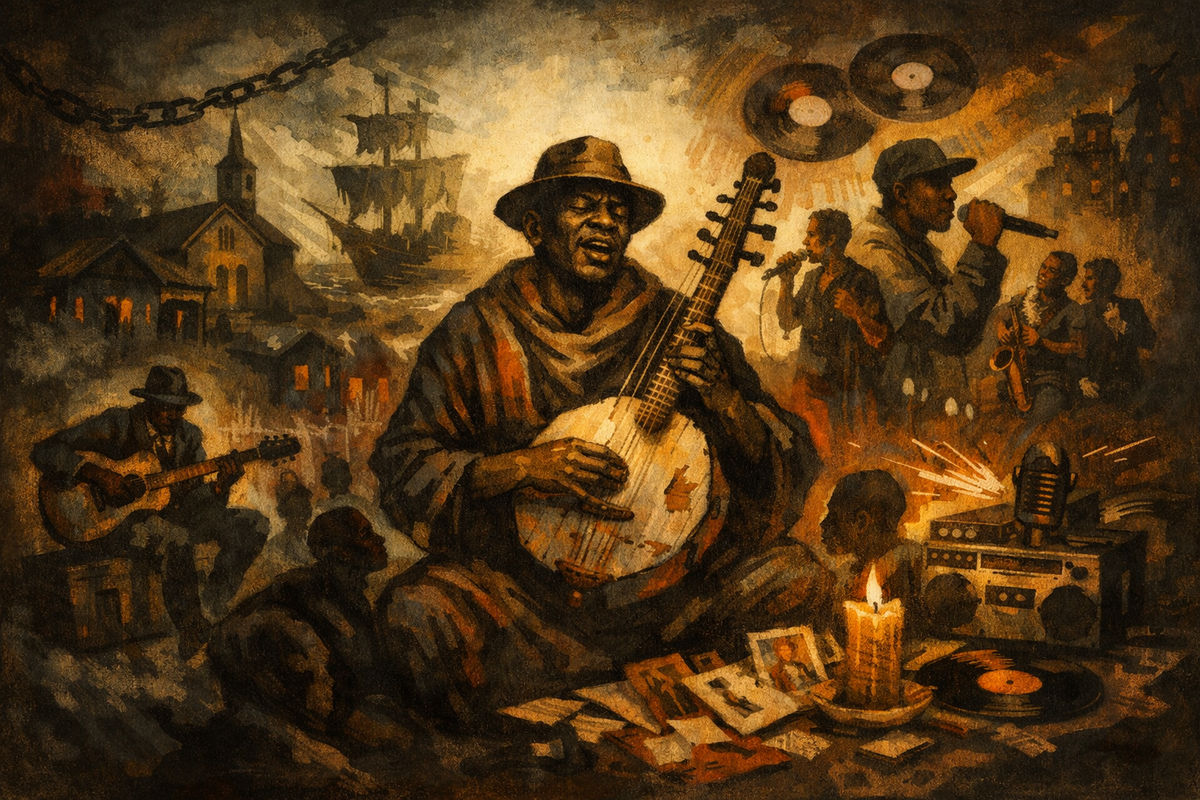
slavery does not preserve social roles cleanly. it tears them out of the worlds that made them legible, smashes kinship and office, and then leaves traces struggling to find new vessels under conditions of terror. so when i say the griot function survives in the african diaspora, i do not mean there is an untouched mande office gliding whole into the americas. i mean something more complicated and, for the purposes of this series, more revealing. the function reconstitutes itself where the need remains and where enough cultural pressure survives to make a new carrier possible.
the need remains very clearly. a violently uprooted people still need memory. they still need public feeling given form. they still need speech from the angle. they still need a figure who can say the unspeakable about the order under which they are living. what changes is the surrounding institution. the old hereditary office is broken. the plantation, the church, the juke joint, the rent party, the street corner, the storefront, the recording studio, the cipher, the stage, the radio, all become partial replacement containers.
that is why the griot-in-diaspora argument cannot be made lazily. it is not enough to say blues or hip hop equals griot and be pleased with oneself. the point is not resemblance alone. the point is function. who holds memory in public. who narrates lineage when lineage has been violently disrupted. who gives a people back to itself in sound. who routes dangerous truth through art forms that can survive the censoring pressure of the dominant order. once one asks those questions, the family resemblance stops being decorative and becomes difficult to ignore.
from office to distributed function
the first change is that the function becomes distributed. in the mande world the jeli office is relatively concentrated. in the african diaspora the same cluster of tasks is spread across preachers, singers, bandleaders, storytellers, blues poets, emcees, and other public carriers of speech and memory. this distribution is not a sign that the function disappeared. it is evidence that the original vessel was broken and the work sought new containers.
that scattered survival is exactly what one would expect under slavery and its afterlives. if kin structure, patronage systems, and hereditary office are disrupted violently enough, the knowledge does not remain institutionally neat. it leaks, adapts, and reassembles around the social spaces still available. the church becomes one such space. music becomes another. oral humor and local narrative become another. later recording technology opens yet another.
blues, jazz, gospel, hip hop
each of the major black american musical formations can be read through this lens without forcing them into sameness. the blues holds testimony, memory, erotic truth, and survival speech at the edge of the acceptable. jazz intensifies improvisation, call-and-response intelligence, and public feeling organized through mastery. gospel binds historical suffering, hope, and collective voice inside a sacred frame. hip hop brings street memory, lineage naming, public boasting, satire, witness, and accusation together in a form explicitly built around verbal authority in public.
none of these are the griot office in a museum-perfect sense. all of them carry pieces of the function. they stage memory. they preserve names. they authorize speech from the angle. they let a people hear itself in public without needing permission from the dominant archive. that is the key. the griot survives where public black speech becomes one of the main places history, warning, and communal self-knowledge are held against erasure.
the emcee as memory worker
hip hop makes the comparison especially vivid because the role of the emcee is so openly about voice, naming, witness, location, competitive authority, and the public management of memory. who came before. who built the sound. what the neighborhood remembers. what the state did. what the media lied about. who is dead and why the dead have to be kept present. this is not a minor side task of the art. it is one of its central offices.
the emcee also inherits the dangerous-speech dimension the earlier griot essay emphasized. truth has to reach power and public at once under conditions where naked statement may be ignored, punished, or rendered inaudible. rhythm changes the cost of truth. rhyme changes the cost. performance changes the cost. again the function returns: not speech in general, but survivable difficult speech.
the archive that sings back
what i like most about the diaspora case is that it keeps the series honest about history. the function survives, yes. it does not survive without rupture. the rupture is part of what gives the new forms their intensity. these are not peaceful continuities. they are pressured continuities. the archive sings back because writing it cleanly was never an option afforded to the people carrying it.
that is why so much black american music feels simultaneously like witness, pleasure, indictment, mourning, and world-making. those functions were once held together in older liminal roles more explicitly. the diaspora redistributes them but does not cease to need them. one can hear the need in the music itself.
the next essay turns to the internet, where one more redistributed liminal function becomes visible again under new conditions: anonymous or masked speech at the edge of consequence.
that is why the diaspora case matters so much to the whole series. it proves that even under catastrophic rupture the function keeps searching for a voice. the voice changes medium, venue, and public. it does not stop trying to gather memory, witness, and difficult truth back into sound.
it also proves that liminal functions do not survive only where tradition is visibly intact. they survive where pressure makes them necessary and where enough collective invention remains to give them form. that matters for the modern essays because it keeps us from making the mistake of thinking continuity must always look ceremonially continuous in order to be real.
This is Part 17 of the liminal caste series.
Previous: the roma today | Hub: the liminal caste | Next: the internet as the new liminal space