
Attachment Styles Are Prediction Strategies
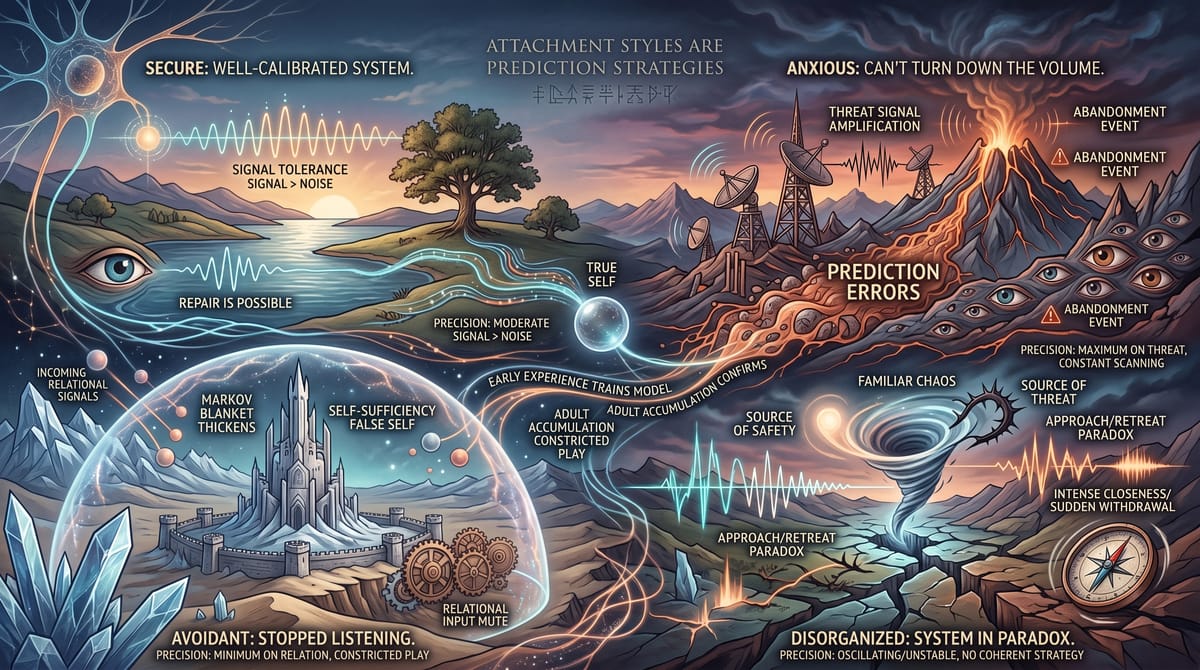
Every therapist you’ve ever seen has asked about your attachment style. Every pop psychology article has sorted you into one of four boxes. You’re secure, anxious, avoidant, or disorganized. Maybe you took a quiz. Maybe you read Attached and saw yourself on every page. Maybe someone you were dating said “I think you’re avoidant” during an argument and you spent the next three weeks wondering if they were right.
Here’s what none of that tells you: why those patterns exist. Not the childhood story; everyone knows the childhood story. Not the behavioral description; everyone can recite the behavioral description. The mechanism. What is actually happening, computationally, in the nervous system of an anxiously attached person versus an avoidantly attached person versus someone who is secure?
Active inference has an answer. And the answer reframes everything.
The Core Reframe
Attachment styles are not personality types. They’re not fixed traits you inherited or acquired and now carry around like eye color. They’re prediction strategies. Specific configurations of the prediction engine described in Chapter 1, each one a different solution to the same problem: how do I minimize prediction error in my closest relationships?
John Bowlby, who built attachment theory in the 1950s and 60s, understood this intuitively even without the computational language. He described what he called “internal working models”; mental representations of how relationships work, built from early experience, that the child carries forward into every subsequent relationship. Mary Ainsworth, his research partner, devised the Strange Situation experiment and identified the patterns empirically. A baby is separated from its mother briefly, reunited, and the reunion behavior reveals the model the baby has built.
What Bowlby called an internal working model, active inference calls a generative model. Same thing, different precision. A generative model is the system’s best prediction about how the world works, used to generate expectations about what will happen next. Your attachment style is your generative model for relationships. It’s the set of priors your prediction engine uses to anticipate what another person will do when you reach for them.
The four styles aren’t four personality types. They’re four different answers to the same question: when I signal need, what happens next?
Secure: The Well-Calibrated System
Secure attachment is a prediction engine running with well-calibrated precision weighting. The system has learned, through a good-enough holding environment, that bids for connection will generally be met. Not always. Not perfectly. But reliably enough that the system can assign moderate precision to social signals without either amplifying them into emergencies or muting them into silence.
When a securely attached person’s partner is distant, the system generates a prediction error. It registers: this doesn’t match my model of how they usually show up. But the error doesn’t cascade. The system checks its assumptions. Maybe they’re tired. Maybe they had a rough day. Maybe it’s about something that has nothing to do with the relationship. The system gathers more data before revising the model. It asks. It waits. It stays curious rather than reactive.
When conflict arises, the secure system treats it as signal, not catastrophe. Prediction errors during a fight are information; they indicate that the models need updating, that something hasn’t been communicated, that a bid was missed. The system can tolerate the discomfort of the error long enough to process it. Repair is possible because the system predicts that repair is possible. That prediction, built from hundreds of successful repairs in the holding environment and in subsequent relationships, is what makes the secure person seem “easy” to be with. They’re not easy. They’re well-calibrated. Their prediction engine generates flexible expectations and updates them without drama.
Winnicott would recognize this as the true self. The secure person’s relational predictions are grounded in actual experience. They’re not performing a strategy designed to manage a caregiver who couldn’t be relied on. They’re predicting from a model that was built on reliable data, and so the predictions tend to be accurate, and so the prediction errors tend to be small, and so the system runs smoothly. Not perfectly. Smoothly.
Anxious: The System That Can’t Turn Down the Volume
Anxious attachment is a prediction engine with the precision dial cranked to maximum on threat-related signals. Every ambiguous cue gets processed through a high-precision threat model. The system is exquisitely sensitive to any signal that might indicate withdrawal, abandonment, or loss of connection. And because the precision is so high on those channels, the system generates enormous prediction errors from tiny inputs.
Partner didn’t text back in an hour? The system generates a prediction error the size of an abandonment event. Not because the person is “dramatic” or “needy.” Because their prediction engine is running a model in which non-response predicts disappearance, and the precision weighting on that prediction is so high that the error signal overwhelms everything else. The sensory channels for “everything is fine” are downweighted. The sensory channels for “something is wrong” are amplified. The system is, in the language of active inference, over-weighting a specific class of prediction errors.
The result is constant prediction error. Constant scanning. Constant need for reassurance to resolve the errors the system keeps generating. The anxious person isn’t choosing to be anxious. Their prediction engine is doing exactly what it was trained to do in the holding environment that built it.
Think about what trains this configuration. It starts early. A caregiver who was inconsistent; sometimes responsive, sometimes absent. The infant’s prediction engine couldn’t build a stable model because the data was noisy. When the data is noisy and the stakes are survival, the rational move is to crank the sensitivity to maximum. Miss a threat signal when the caregiver is the only thing keeping you alive, and you die. Generate a false alarm when they’re actually fine, and you just cry for a few extra minutes. The system learns to never miss a signal, because the cost of a miss is catastrophic and the cost of a false alarm is merely uncomfortable. That was rational, given the data the system had to work with.
But the training didn’t stop there, and this is the part that matters for understanding why the configuration is so hard to shift in adulthood. The first boyfriend who ran hot and cold confirmed the model: love is unreliable, monitor harder. The story told after that breakup; “I should have seen the signs”; trained the system to scan earlier, scan more, to treat the absence of data as its own kind of danger signal. The next relationship, chosen partly because the intensity felt familiar, provided more confirming data. The friend who said “you’re too much” updated the narrative layer with something even more insidious: the system is correct that love is precarious, and maybe the precariousness is your fault. Each step was rational. Each update was the best available interpretation of the evidence on hand. And the configuration compounds, because each confirming experience makes the next one more likely.
By adulthood, the anxious person isn’t running a childhood program in an adult body. They’re running a model that has been confirmed by twenty years of accumulated evidence, most of it gathered from environments the model itself selected. The partner who doesn’t text back isn’t the inconsistent caregiver. But the prediction engine doesn’t distinguish between sources of confirmation. It’s running the model that every relational environment so far has validated.
Winnicott would call this a false self built for surveillance. The anxious person’s relational predictions aren’t grounded in the current relationship. They’re grounded in accumulated data from every environment where love was real but unreliable, and the only way to get it was to monitor for it constantly. The prediction engine never learned to trust the blanket. So it watches. Endlessly. And the watching was rational at every step.
Avoidant: The System That Stopped Listening
Avoidant attachment is the opposite configuration. Instead of cranking precision to maximum on social signals, the system has learned to downweight them entirely. The prediction engine runs low precision on relational inputs across the board.
Partner expresses a need? The signal barely registers. Not because the avoidant person doesn’t care; because the system learned early that processing relational signals leads to prediction errors it can’t resolve, and the most efficient way to minimize prediction error is to stop processing the signals that generate it. If you can’t predict whether the caregiver will respond, and failed predictions cost too much, the rational move is to reduce the precision on the whole category. Stop expecting. Stop needing. Stop listening for response, because listening generates errors you can’t fix.
The Markov blanket thickens. In the formal math, this describes a change in the statistical relationship between internal and external states; mapped onto a person, it means the boundary between the avoidant person’s internal states and the social world becomes less permeable. Fewer signals get through. The system maintains stability by refusing to update its model in response to relational data. A partner’s bid for connection arrives at the blanket and bounces off; not because the avoidant person has rejected it consciously, but because the system has deprioritized that entire class of input.
The initial training often involves a caregiver who was reliably unavailable. Not chaotic like the anxious pattern; the caregiver wasn’t a coin flip. The infant signaled distress and nothing happened. It signaled need and nothing changed. The prediction engine built the only stable model available: other people don’t respond to my signals, so the most efficient thing to do with relational need is to stop generating it. That was rational, in the way that shutting a window during a storm is rational; it solves the immediate problem while sealing off something the system will eventually need.
And then adolescence reinforced it. The avoidant kid often excelled at things that didn’t require relational processing; academics, sports, solitary projects. Adults praised the independence. Peers respected the self-sufficiency. The model received external validation from every direction: not needing people is a strength. The first relationship, if it came, often ended because the partner wanted more access than the system could provide. The story after: “I’m just not a relationship person.” The next attempt, shorter. The story refining itself: “I’m better alone.” Each story rational. Each an accurate description of what the model produced. None of them questioning whether the model itself could be reconfigured.
By adulthood, the avoidant person has built a life that confirms the prediction at every level. Career rewards independence. Social circle respects the distance. The rare partner who gets close encounters a system that functions beautifully in every domain where relational signals don’t matter and deflects the moment someone asks for high-precision emotional data. “What are you feeling? What do you need from me? Can we talk about this?” The system encounters a demand it was built, across two decades of rational trade-offs, to avoid.
Winnicott would call this a false self built for self-sufficiency. The avoidant person’s relational predictions aren’t absent; they’re actively constrained. The system learned to stop playing in the relational space because play in that space generated unresolvable errors. The thick blanket isn’t preference. It’s protection. And the protection has a cost: the signals that could update the model, that could teach the system that relationships can be different now, can’t get through. But the protection was rational at every step. That’s what makes it so hard to question.
Disorganized: The System in Paradox
Disorganized attachment is the configuration that breaks the framework’s elegance, because it’s a system that can’t settle on a strategy at all.
The anxious system has a strategy: amplify everything, scan constantly, pursue reassurance. It generates enormous prediction error, but the strategy is coherent. The avoidant system has a strategy: mute relational signals, thicken the blanket, minimize input. It generates a different kind of suffering, but the strategy is coherent. Disorganized attachment has no coherent strategy, because the data it was trained on made coherence impossible.
The holding environment that produces disorganized attachment is one where the source of safety is also the source of threat. Mary Main and Erik Hesse identified this pattern in the 1990s: infants whose caregivers were simultaneously the attachment figure and the source of fear. Abuse is the obvious case, but it’s not the only one. A caregiver who is deeply frightened; by their own trauma, by psychosis, by unprocessed grief; transmits that fear to the infant through the same channels that should transmit safety. The infant approaches for comfort and encounters terror. The infant retreats from threat and loses the only source of comfort available.
The prediction engine can’t build a coherent model because the same input generates contradictory predictions. Approach predicts both safety and danger. Withdrawal predicts both protection and abandonment. The system oscillates rather than settling. It generates high prediction error in both directions simultaneously, and neither strategy; amplify or mute; resolves the paradox.
In adult relationships, this looks like the push-pull that destabilizes everything it touches. Intense closeness followed by sudden withdrawal. Desperate need followed by inexplicable rage at the person meeting the need. The partner can’t predict which version will show up because the disorganized person can’t predict it either.
And the adult accumulation is particularly cruel here. Because the disorganized person’s relationship history tends to be chaotic; not randomly, but because a system running contradictory predictions selects and generates contradictory environments. The partner who was both tender and terrifying confirms the model. The relationship that oscillated between the best and worst thing in your life confirms the model. The story afterward; “I always pick the wrong person”; confirms the model while misidentifying the mechanism. The system isn’t picking wrong. The system is gravitating toward environments that match its contradictory architecture because those are the environments where the prediction engine generates the fewest novel errors. Familiar chaos is, computationally, less expensive than unfamiliar safety, because the prediction engine at least knows how to process chaos; it has decades of training data for that. Unfamiliar safety generates errors the system has no template for, and the absence of a template feels, paradoxically, more dangerous than the chaos it already knows how to survive. Every step in this process was rational. Every outcome confirming.
Winnicott would recognize this as the most profound failure of the holding environment, compounded across a lifetime. Not absence; that produces avoidance. Not inconsistency; that produces anxiety. Contradiction. The blanket itself was the source of the chaos it was supposed to buffer. The system can’t build a stable blanket because it can’t determine what’s inside and what’s outside. Safety and threat occupy the same location. The prediction engine spins.
What Changes When You See It This Way
The conventional framing of attachment styles is descriptive. You’re anxious; you cling. You’re avoidant; you withdraw. You’re disorganized; you do both at once. The descriptions are accurate but they stop at the surface. They tell you what you do without telling you what’s driving it.
The active inference framing goes one layer deeper. You’re anxious because your precision weighting on threat signals is too high. You’re avoidant because your precision weighting on relational signals is too low. You’re disorganized because your system can’t assign stable precision weights to anything because the training data was contradictory. You’re secure because your precision weights are well-calibrated; flexible enough to register signal without amplifying noise.
This matters because it changes the target of intervention. If attachment styles are personality types, you’re stuck with them. If they’re prediction strategies, the question becomes: can the prediction engine learn a different strategy? Can precision weights be recalibrated? Can the generative model be updated?
The answer is yes. Not easily. Not by knowing the answer intellectually. The prediction engine doesn’t update through insight; it updates through experience. New relational experiences that disconfirm the old predictions in tolerable doses, processed by a system that’s in a state where it can actually integrate the new data. That’s earned secure attachment. It’s not a personality transplant. It’s a recalibration of the prediction engine; turning down what’s too loud, turning up what’s too quiet, learning to assign precision to signal rather than to the noise the old environment taught you to expect.
But the mechanism of that recalibration; how it works, what it requires, why most self-help advice about it fails; that’s later in this book. First, we need to understand the boundary where all of this plays out. The membrane between your inner world and the person sitting across from you. The Markov blanket of a relationship.