
The Markov Blanket of a Relationship
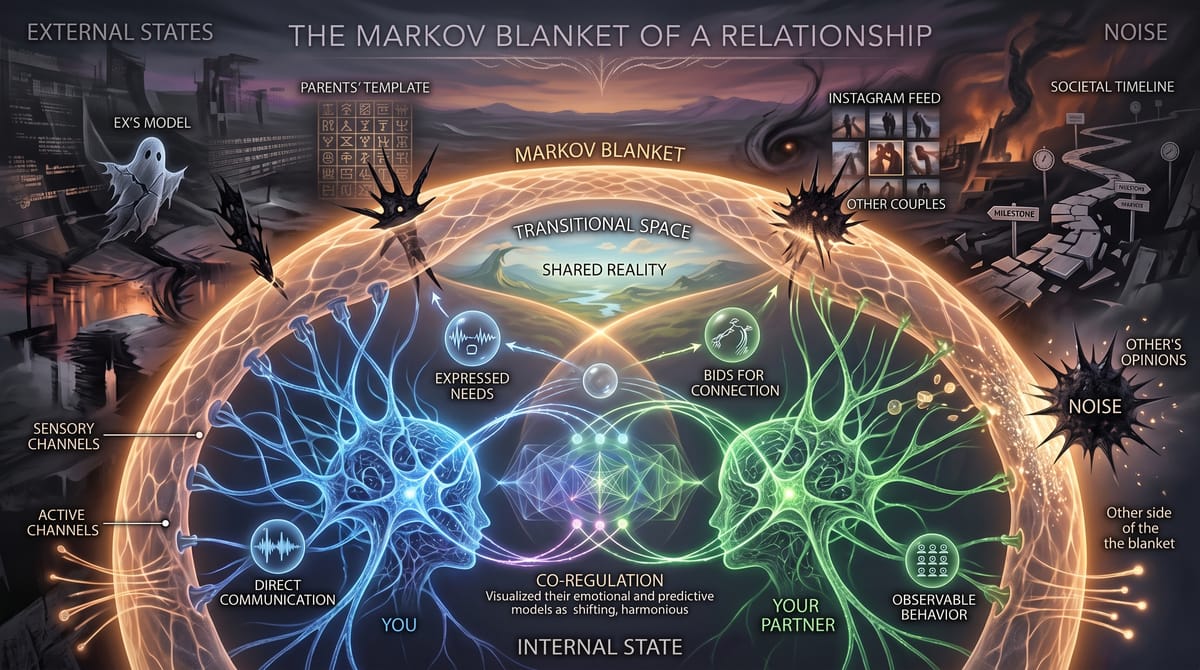
Everybody talks about boundaries. Set boundaries. Maintain boundaries. Respect other people’s boundaries. The word gets used so often in therapeutic culture that it’s lost most of its precision. It means everything from “I don’t answer work emails after 6pm” to “I need you to stop talking to your ex” to “I won’t tolerate being yelled at.” All valid. None of them precise enough to be useful as a framework.
Active inference has a version of boundaries that is precise. It’s called a Markov blanket, and it isn’t a recommendation or a preference or a therapeutic goal. In the math, it describes the statistical boundary of any self-organizing system; the partition that makes a thing a thing rather than undifferentiated noise. Cells have them. Brains have them. What this book does is map that mathematical structure onto relational life; not because the math literally describes your marriage, but because the geometry is so useful that once you see it, you can’t unsee it.
Understanding the Markov blanket won’t just change how you think about boundaries. It will change how you think about where you end and your relationship begins.
What a Markov Blanket Actually Is
In the formal framework, a Markov blanket is the set of states that separates a system’s internal states from its external states. It’s the boundary that makes something a something rather than an undifferentiated part of the soup. Your skin is a Markov blanket in the most literal sense; it’s the membrane that separates your internal biology from the environment. But the concept extends beyond the physical.
The blanket has two kinds of states, and this is where it gets useful.
Sensory states are the channels through which external information reaches your internal model. Your eyes, your ears, your skin, your gut. In a relationship, sensory states are the signals you actually process from your partner: their words, their tone, their facial expressions, their bids for connection, their behavior over time. These are the inputs your prediction engine uses to update its model of the relationship.
Active states are the channels through which your internal states affect the external world. Your speech, your actions, your expressions, your choices. In a relationship, active states are how you show up: what you say, what you do, how you respond to bids, what you express and what you withhold.
The blanket is the interface. It’s not a wall; it’s a membrane. It lets certain signals through and blocks others. It processes inputs and generates outputs. The question isn’t whether you have a Markov blanket; you do, mathematically, or you wouldn’t exist as a distinct entity. The question is whether your blanket is doing its job well.
Your Relationship Has a Blanket Too
Here’s where it moves from math to Tuesday night.
Every relationship is a system. Two prediction engines, each with its own Markov blanket, coupled through their sensory and active states. When two systems couple this way, they form a superordinate system; a higher-order entity with its own blanket. Friston’s math allows for this; cells form organs, organs form bodies, and two nervous systems, entangled through co-regulation, form something that is neither one person nor the other. The relationship’s blanket is the boundary of that coupled system. Inside it: the signals that belong to the relationship. Outside it: everything else.
Inside the blanket: the signals that legitimately belong to the relationship. Your partner’s direct communication. Their bids for connection. Their expressed needs and desires. Their observable behavior. Your own expressed needs, your bids, your communication, your behavior. This is the data the relationship’s prediction engine should be running on. This is signal.
Outside the blanket: everything else. And this is where most relational suffering actually lives.
Your ex’s model of relationships? Outside. Your parents’ marriage template, the one that got installed before you had language to question it? Outside. Instagram’s highlight reel of other couples, the algorithmic curation of everyone else’s best moments measured against your private worst? Outside. Society’s timeline for when you should be married, having kids, buying a house, reaching some milestone that proves your relationship is “on track”? Outside. Your friend group’s opinions about your partner; their unsolicited assessments, their comparisons, their projections of their own relational failures onto yours? Outside.
All of it. Outside the blanket. Not because those influences don’t exist, and not because they can’t be discussed within the relationship, but because they are external states. They don’t belong inside the model that the relationship runs on. When they penetrate the blanket; when they start updating your internal model of the relationship through channels that shouldn’t be open; that’s not a boundary violation in the therapeutic sense. It’s a blanket breach. Noise getting in where signal should be.
The Mother-in-Law Problem, Precisely
Here’s the concrete version.
Your mother-in-law has opinions about how you’re raising your kids. She expresses them frequently. She expresses them to your partner, who then carries them into conversations with you. You feel pressure building. You feel defensive. You start second-guessing decisions that felt clear before she weighed in. You and your partner fight about parenting in ways that have her fingerprints all over them but never mention her name.
The conventional framing says: set a boundary with your mother-in-law. Tell her to stop. Or tell your partner to stop relaying her opinions. Or work on not letting it bother you.
The Markov blanket framing says something more precise. The problem isn’t that she has opinions. Everyone has opinions. The problem is that her opinions are penetrating your blanket; they’re updating your internal model of your parenting, your partnership, your competence, through channels that shouldn’t be open. Her parenting philosophy is an external state. It belongs on the other side of the blanket. When it gets through, it generates prediction errors inside a system it doesn’t belong to.
The fix isn’t to argue with her. Arguing with external states is a game you can’t win because external states are infinite. There will always be another opinion, another comparison, another voice from outside the system trying to update the model inside. The fix is to recognize where the signal is coming from and close the channel. Not by cutting her out of your life. By recognizing, in real time, that this data is arriving from outside the blanket and doesn’t belong in the model.
“Other side of the blanket.”
That’s the phrase. That’s the practice. When external noise arrives at the boundary of your relationship and starts trying to update the model inside, the move is recognition, not reaction. This signal is not from inside the system. It doesn’t get to update the model. I can perceive it without processing it. I can acknowledge it without integrating it.
The Signals You’ve Left the Door Open For
Most people, when they hear about the Markov blanket, immediately identify the obvious intruders. The mother-in-law. The ex. The friend who always has opinions. Those are the easy ones.
The harder question is: what signals are you letting through that you don’t even notice?
The relationship escalator is one. The cultural script that says relationships must progress along a specific track; dating, exclusivity, moving in, engagement, marriage, kids, death; is an external state. It’s a prediction model generated by a culture, not by your relationship. But it penetrates most people’s blankets so thoroughly that they can’t distinguish between “I want to get married” and “the script says I should want to get married by now.” The prediction errors generated by being “behind schedule” feel like they’re coming from inside the relationship. They’re not. They’re coming from a cultural model that’s breached the blanket and is now generating errors inside a system it has nothing to do with.
Social media is another. The algorithmic presentation of other couples’ lives is an external state designed to generate prediction error. That’s not a conspiracy theory; that’s the business model. Platforms profit from engagement, engagement is driven by prediction error, and nothing generates relational prediction error faster than a curated image of someone else’s relationship measured against the unfiltered reality of your own. When you scroll past a couple’s anniversary post and feel something tighten in your chest; a comparison, a doubt, a flicker of “why don’t we do that?”; that’s an external state penetrating your blanket and updating your model with data that has nothing to do with the actual relationship you’re in.
Your own historical models are perhaps the most insidious. The prediction templates from past relationships; the ex who cheated, the parent who left, the friend who betrayed; these are models built from real data. They were accurate once. But when they start generating predictions inside a new relationship, they’re external states wearing the disguise of internal ones. The prediction “this person will leave” might feel like it’s coming from the current relationship. It’s not. It’s coming from a model built in a different system, penetrating the blanket of this one, generating errors against a partner who hasn’t earned them.
This is what makes the Markov blanket framework harder than simple “boundary setting.” A boundary keeps something out. A Markov blanket requires you to identify where signals are actually coming from. And some of the most disruptive signals feel like they originate inside the system because they’ve been penetrating your blanket for so long that you can’t remember when they arrived from outside.
Transitional Space
There’s a subtlety here that the math alone doesn’t capture, and Winnicott gets at it better than Friston.
The Markov blanket of a relationship isn’t just a boundary. It’s the membrane of what Winnicott called transitional space; the area of experience that is neither purely internal nor purely external. The relationship itself lives in transitional space. It’s not inside you; it exists between you and another person. It’s not outside you; it’s constituted by your internal states, your predictions, your models. It’s the overlap.
Winnicott’s transitional object; the blanket or stuffed animal that the toddler carries everywhere; is the first version of this. The object is real, external, a thing in the world. But it’s also charged with the child’s internal states; it carries safety, comfort, the felt presence of the mother even when she’s absent. It’s neither purely subjective nor purely objective. It lives in the space between.
A healthy relationship lives in the same space. The Markov blanket of the relationship isn’t a rigid wall; it’s a living membrane that allows certain signals through, processes them, and maintains the distinction between what belongs to the relationship and what doesn’t. Inside the blanket, two people’s inner worlds overlap without collapsing into each other. You can feel your partner’s sadness without it becoming your sadness. You can hold their anger without it rewriting your model of yourself. You can share a reality without merging into one undifferentiated system.
Here’s what this looks like on a Tuesday. Your partner comes home and tells you about a conflict at work. They’re activated. The story is charged. And you hold it. Not by fixing it, not by absorbing the activation into your own nervous system, not by dismissing it. By being present in transitional space; the space where their experience is real, where you can feel the weight of it, where you care about it genuinely, and where it remains theirs. You’re inside the blanket with them, processing their signals, and simultaneously maintaining the membrane that keeps their work conflict from becoming your prediction error. Their anger at their boss doesn’t update your model of whether the two of you are okay. Their stress doesn’t become your stress through contagion. You hold their experience the way Winnicott’s child holds the transitional object; it’s real, it matters, and also it doesn’t merge with your own internal state. That’s the membrane doing its job.
Compare this to enmeshment, where the membrane has dissolved. Your partner comes home upset and within minutes you’re more upset than they are. Their stress has crossed the blanket and become your stress. Their anger has updated your model; now you feel like something is wrong between you, even though the conflict is at their office. The prediction engine is running on data that came from outside the relationship’s system and treating it as signal from inside. That’s not empathy. That’s a blanket breach.
When the blanket is too rigid; when nothing gets through; you have two avoidant systems living parallel lives in the same house. The membrane has become a wall. Transitional space collapses because there’s no overlap. Your partner comes home upset and you register it as information that doesn’t concern you. The signal bounces off the wall. They feel alone in their own relationship.
The well-functioning blanket maintains the paradox. Connected but distinct. Overlapping but not merged. Open to signal, closed to noise. Winnicott spent his career describing this paradox; the capacity to be alone in the presence of another, to play in a space that is neither purely yours nor purely theirs, to hold experience as real without being consumed by it. This is Winnicott’s transitional space rendered in the language of computational neuroscience, and it’s the relational sweet spot that every subsequent chapter in this book builds toward.
The Practice
“Other side of the blanket” is not a thought experiment. It’s a real-time practice, and it works best when it’s specific.
When your partner comes home and you feel tension before they’ve said a word; ask yourself: is this signal from inside the blanket, or am I generating a prediction error from a model that doesn’t belong to this relationship?
When you’re lying in bed comparing your relationship to the one described in your friend’s breathless text message; ask yourself: whose data is my prediction engine running on right now?
When you feel pressure about a timeline; marriage, kids, the next step, whatever cultural script is generating the urgency; ask yourself: is this prediction coming from inside the system, from what my partner and I have actually discussed and decided together, or is it an external model that breached the blanket so long ago I forgot it wasn’t mine?
The Markov blanket doesn’t tell you what to feel. It tells you where the feeling is coming from. And in relationships, that distinction is everything. Because most of the fights you’re having aren’t about the relationship. They’re about signals from outside the blanket that you’ve been treating as if they came from inside. Close the channel, and the prediction error resolves. Not because the problem disappears, but because you’ve correctly identified that it was never the relationship’s problem to solve.
The relationship has enough real prediction errors to manage. It doesn’t need to borrow them from the world outside the blanket.